
The U.S. Consulate in Naples and the Roots of Transatlantic Diplomacy
By Amedeo Arena
In 1796, only twenty years after the Declaration of Independence, the young American Republic opened a consular post in Naples. Yet the bond it sealed was older still, nourished by an exchange of ideas that had already been traveling across the Atlantic from Enlightenment Naples — a city that, in the second half of the eighteenth century, stood among the great intellectual capitals of Europe.
At the centre of that intellectual ferment was Antonio Genovesi, who in 1754 ascended the first European chair of political economy, established at the University of Naples. Around his teaching there grew a whole generation of thinkers for whom the purpose of law and government was not the glory of the prince, but the pubblica felicità — the public happiness — of the citizens. Two figures shaped by this Neapolitan intellectual climate would carry its lessons into the heart of the American founding: a patriot and a jurist, Pasquale Paoli and Gaetano Filangieri.
Formed in the Naples of Genovesi, the Corsican patriot Pasquale Paoli absorbed there the civic ideals that he would soon put into practice on his native island. In 1755, he led Corsica to independence from the Republic of Genoa and promulgated a constitution dedicated to the “happiness of the nation” — a phrase unmistakably Neapolitan in its philosophical lineage.
Across the Atlantic, the Sons of Liberty looked to Paoli as a hero of republican virtue. Echoes of his language — and, through him, of the Neapolitan teaching that had inspired it — can be traced in the Virginia Declaration of Rights of 1776 and, most famously, in the Declaration of Independence itself, which enshrined the “pursuit of happiness” among the unalienable rights of all.
A generation later, another son of Enlightenment Naples would bring the city into direct dialogue with the American founders. Gaetano Filangieri was the young Neapolitan jurist whose Scienza della Legislazione, published from 1780 onward, was reshaping European legal thought just as the American Republic was taking shape. In 1782, Benjamin Franklin wrote to him from Paris, opening a correspondence that would endure until Filangieri’s untimely death in 1788.
In what would be his last letter, Franklin sent the Neapolitan philosopher a copy of the newly proposed U.S. Constitution, with a heartfelt acknowledgement of his “invaluable work on legislation” — a quiet but telling recognition of the Neapolitan’s contribution to the constitutional imagination of the new republic.
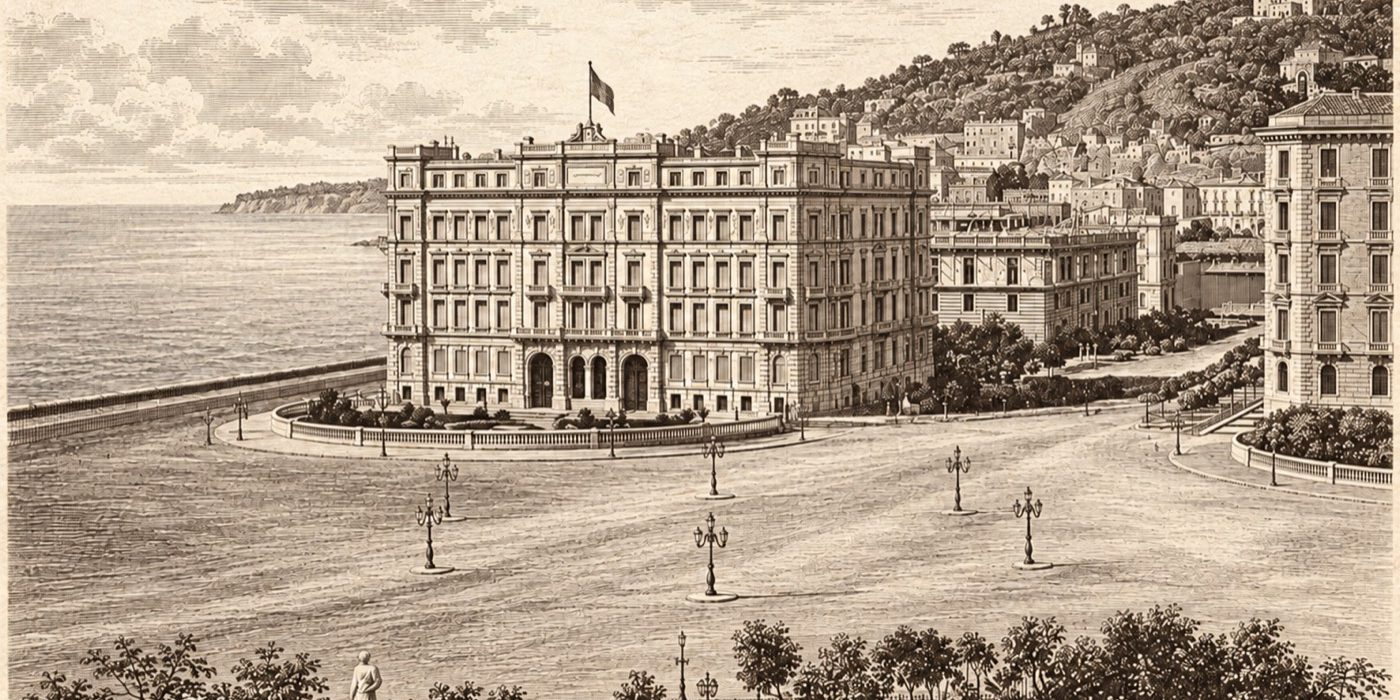
The consulate’s present waterfront location adds an architectural chapter to this history. Overlooking the Bay of Naples, the site once housed the Grand Hotel, established in 1880 by the Swiss hotelier Alfred Hauser. In the postwar years, the hotel gave way to a purpose-built American consulate, constructed between 1951 and 1953 from a design by George Howe, subsequently revised by the Italian architect Mario De Renzi. The building thus embodies another encounter between Italy and the United States, expressed through architecture as well as diplomacy.
Seen against this background, the opening of the U.S. Consulate in Naples in 1796 appears not as a beginning but as the institutional seal of a conversation already well under way — one in which Neapolitan ideas had helped to shape the very vocabulary of American liberty.
Image: AI-generated illustration inspired by the Grand Hotel in Naples in the late nineteenth century, on the site of today’s U.S. Consulate General.