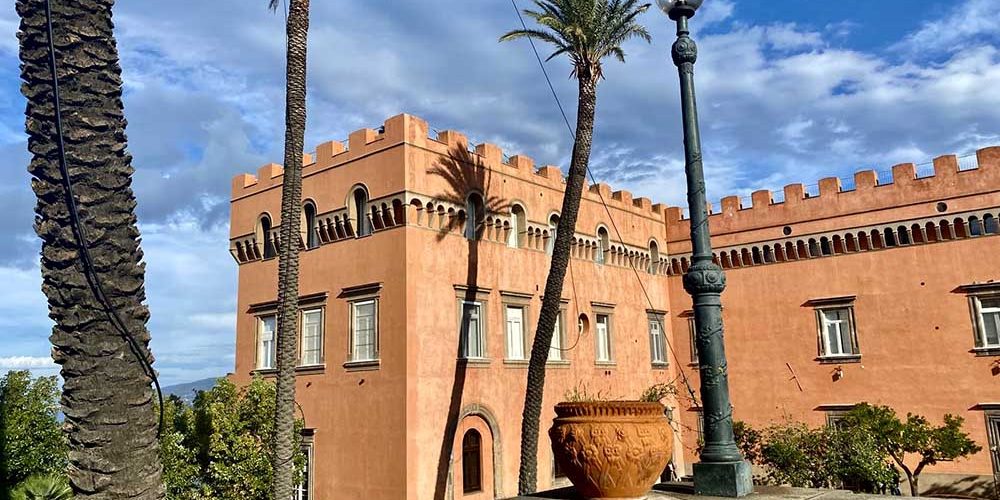
Gaetano Filangieri and the Castle at Vico Equense
By Amedeo Arena
For Americans visiting Italy’s Sorrento Peninsula, Castello Giusso holds an unexpected connection to their country’s founding. Here, in the summer of 1788, the Neapolitan philosopher Gaetano Filangieri received a letter from Benjamin Franklin enclosing a copy of the United States Constitution.
Filangieri had arrived in Vico Equense in the spring of 1787 with his wife, Charlotte Frendel, and their sons, Carlo and Roberto. He was thirty-three, and his Science of Legislation had already made his name known across Europe and in America. His ambition was to explain how better laws could make human happiness possible.
The castle stood above the Bay of Naples, surrounded by pine and olive trees. Founded in 1289, it had been transformed over the centuries from a coastal fortress into an aristocratic residence. Filangieri’s host was his brother-in-law, Filippo Ravaschieri, Prince of Satriano, who had married the philosopher’s sister Teresa.
There, Filangieri hoped to find time for his work. His appointment to the kingdom’s Supreme Council of Finance required his presence only two days a week, he explained to his Danish friend Friedrich Münter. The remaining days were available for his book.
He was working on its fifth volume, devoted to religion, among the most sensitive subjects in his sweeping program of reform. Writing demanded extraordinary discipline: in a letter to the scholar Giulio Bernardino Tomitano, he recalled that few days of his life had involved fewer than eleven hours of work.
Across the Atlantic lay a country he had once hoped to call home. In December 1782, Filangieri had written to Franklin that Philadelphia had attracted him since childhood. He had grown so accustomed to imagining it as the only place where he could be happy that he could no longer shake the idea.
Could his writings secure an invitation to Pennsylvania, he asked, where he might contribute to the great legal code taking shape amid the promise of new freedom? That voyage never took place. Their correspondence nevertheless sustained a conversation between an American founder and an Italian thinker who believed that laws should serve the pursuit of “public happiness”.
On July 1, 1788, a packet arrived from Philadelphia containing Franklin’s letter of October 14, 1787, written less than a month after the Constitutional Convention adopted and signed the Constitution on September 17. Franklin enclosed a copy of that founding document, believing Filangieri would be curious to learn what was happening in America. The gift was also a token of appreciation for what he called Filangieri’s “invaluable Work”: in the same letter, he requested multiple copies of the existing volumes and eight of any further volumes published.
However, that same day, Filangieri developed the fever from which he would never recover.
Friends hurried to his bedside. The physician and naturalist Domenico Cirillo traveled with Mario Pagano, the jurist who would later help shape the constitution of the short-lived Neapolitan Republic of 1799. Their nighttime crossing toward Vico was frightening: rough water and anxious silence deepened their fear of what awaited them.
At the castle, they found Filangieri gravely ill, watched over by Charlotte. Cirillo later recalled her desperate devotion to the husband whose life she would willingly have saved with her own blood.
Shortly before midnight on July 21, 1788, Filangieri died, weeks before his thirty-fifth birthday. His work remained unfinished. News of his death spread through Europe and reached American newspapers. Charlotte wrote to Franklin in French: a cruel illness had taken her husband in the prime of life, and with him all her happiness. Filangieri was buried in Vico Equense’s cathedral, a short walk from the castle.
During the nineteenth century, the property passed to the Giusso family, Genoese merchants who gave it the battlemented appearance visitors recognize today. In 1870, Count Girolamo Giusso placed an inscription above the entrance recalling that Filangieri “meditated and wrote part of his distinguished work, The Science of Legislation” in the castle, thereby sparing the world “many tears, much bloodshed, many crimes sanctioned by law.” It then addresses the visitor: “Traveler, you who visit this delightful retreat where that great man died, remember with gratitude his brief life and the intellect he devoted wholly to the benefit of humankind.”
In this spirit, a series of conferences at the castle has kept Filangieri’s memory alive. On June 15, 2004, the castle hosted the international conference “Filangieri and Franklin: From the United States Constitution to a European Fundamental Charter,” associated with the City of Vico Equense and New York’s Columbus Citizens Foundation. On September 4, 2026, another conference, organized by the Accademia Filangieri di Partenope, returned to their correspondence under the title “From Philadelphia to Vico Equense in the Age of Enlightenment.”
At the latter gathering, a proposal emerged to name the hall after Filangieri. It would give a permanent name to a space where people already come together to discuss his ideas, carrying the inscription’s invitation beyond the castle entrance. Visitors would be encouraged to engage with the questions that animated his work: what makes laws just, whom they serve, and how they can improve people’s lives.
The Declaration of Independence’s 250th anniversary gives that proposal particular resonance. Americans celebrating the pursuit of happiness can find in Vico Equense a European thinker who made public happiness the measure of good government. A hall bearing his name could offer a place to continue that transatlantic conversation, welcoming scholars, citizens, and travelers into the home where he once imagined a better future.
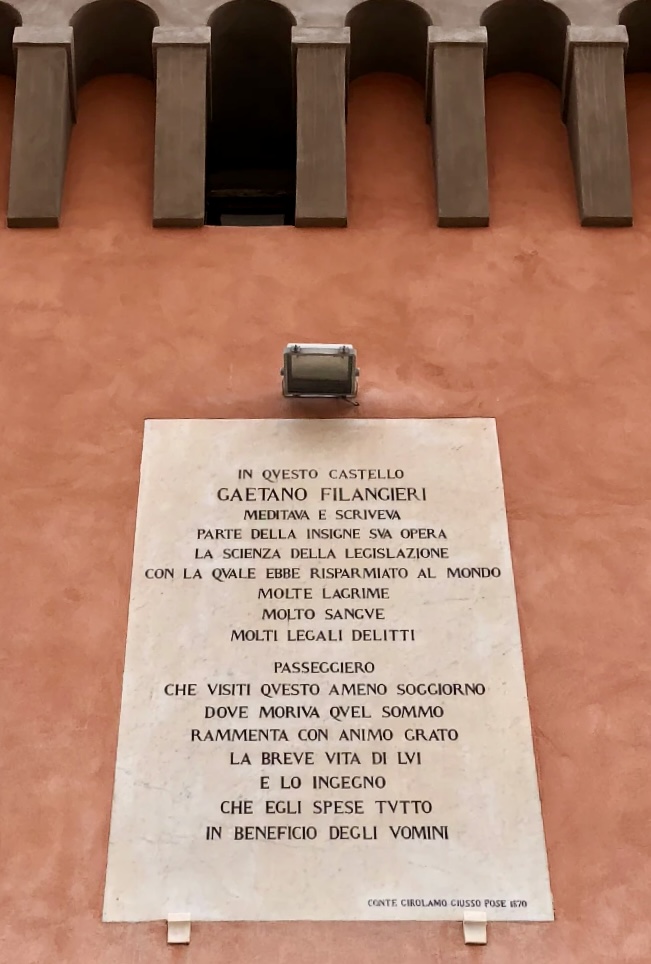
Photographs: (above) the exterior of the hall at Castello Giusso in Vico Equense proposed to be named in honor of Gaetano Filangieri; (below) the commemorative marble tablet installed by Count Girolamo Giusso in 1870, honoring Filangieri and his work on legislation at the castle.