

Happiness as the Purpose of Law: Body, Virtue, and Citizenship in Filangieri
By Francesca De Rosa*
What should the law ultimately achieve? For Gaetano Filangieri, the answer was not simply order or obedience. Legislation should make public happiness possible. In the late eighteenth-century Kingdom of Naples, this ideal gave reform a practical purpose: laws were to improve people’s material conditions, widen access to education, and help citizens develop the capacities needed to participate in civic life. In Book IV of The Science of Legislation, Filangieri made education central to that project, beginning with a subject that may seem unexpected: the body.
Filangieri wrote amid a period of reform across Europe and the Italian peninsula. In Naples, universities and learned institutions were being reorganized, and reformers debated how knowledge could serve public life. He drew on a southern Italian tradition that included Antonio Genovesi, who had argued that economic policy should promote common happiness and that educating the people was essential to achieving it. Filangieri carried this discussion into the domain of law. Happiness, in his account, was not a private feeling or a privilege reserved for the wealthy. It depended on the conditions created by a just legal order.
That idea connected individual wellbeing to the health of the political community. A state could not be happy if its people lived in misery and ignorance; citizens could not flourish where institutions failed to protect their rights and opportunities. The legislator therefore had a positive responsibility: not only to punish wrongdoing, but to remove barriers to human development. Poverty, ignorance, and corruption were social conditions that legislation should confront.
Education was one of the most important tools for that work. Filangieri distinguished physical, moral, and intellectual education, but he treated them as stages of a single formation. Education helped shape the future citizen, preparing people to govern themselves and contribute to the common good. The family had a role in forming individuals, he argued, but public education was necessary to form a people. Without it, there might be a city, but not a community of citizens.
His approach gave education a legal and political status. The state was not merely to regulate schools after they existed; it had a duty to make public instruction part of the foundations of civic life. This placed Filangieri in debate with approaches that left education mainly to families or religious institutions. He also emphasized prevention: cultivating virtue and sound judgment could do more for society than relying on punishment after harm had occurred.
The sequence began with physical education. Filangieri believed that health, strength, and self-control helped people develop the capacities required for moral judgment and civic participation. His proposals included exercise, hygiene, simple habits, and regular routines. He imagined public spaces, teachers, and shared practices that would make physical education broadly accessible. Rather than treating bodily care as a private concern or a luxury, he made it part of public responsibility.
This emphasis may sound surprising today, and some of Filangieri’s prescriptions reflect the assumptions of his own time. Yet the underlying argument was political: a person’s ability to participate in public life is affected by health, poverty, and access to education. If physical weakness and deprivation are unequally distributed, civic equality is limited as well. For Filangieri, the body was therefore one of the places where the law’s promises became real—or failed to do so.
Physical education, in this view, was not intended to create an army of soldiers. Filangieri imagined citizens able to act with steadiness, moderation, and independence. Shared activities and habits could strengthen social ties, while discipline could help individuals master their impulses. The purpose was not blind obedience. It was to develop self-command, so that people could live under laws they understood and recognized as serving the common good.
Here lies a tension in Filangieri’s model. Public education can enable freedom, but it can also give the state power to shape personal life. His confidence in the legislator’s capacity to form citizens raises questions that remain relevant: who decides which habits count as virtuous? How can public policy promote health and learning while respecting individual differences and liberty? Filangieri’s work does not resolve every difficulty, but it makes clear that the pursuit of happiness depends on both institutions and the safeguards that limit their power.
For him, the movement from body to morality to knowledge was a path toward citizenship. Physical education could cultivate self-control; moral education could direct the will; intellectual education could equip people to reason. The goal was a citizen able to contribute to society, not simply a subject who followed commands. Law, in turn, gained legitimacy by helping people develop and by distributing the means of that development more fairly.
This conception belongs to a wider Enlightenment debate about happiness and government. Cesare Beccaria had made the greatest happiness of the greatest number a guiding principle of penal reform. Filangieri shared the concern for public wellbeing, but placed particular emphasis on building the social and educational conditions that made a good life possible. His correspondence with Benjamin Franklin offers a transatlantic setting for these concerns. Both men engaged with questions of legislation, education, and the public good, though their political contexts and projects were distinct.
Filangieri’s influence and reception extended beyond his lifetime, even as his reputation later faded amid changing political and intellectual currents. His questions have not disappeared. Modern societies continue to debate public health, universal education, equal opportunity, and the responsibilities of government. These are not simply technical matters: they shape whether people can exercise their rights and take part in civic life.
In The Science of Legislation, physical education is not an isolated recommendation. It is part of a larger claim about the purpose of law. A just legal order should help people become healthy, educated, and capable of freedom. Public happiness is not an abstract promise delivered from above; it depends on institutions that protect rights and enable citizens to develop their abilities. Filangieri’s project invites us to ask whether laws are judged only by the order they maintain, or also by the lives they make possible.
* Associate Professor of History of Law, University of Naples Federico II
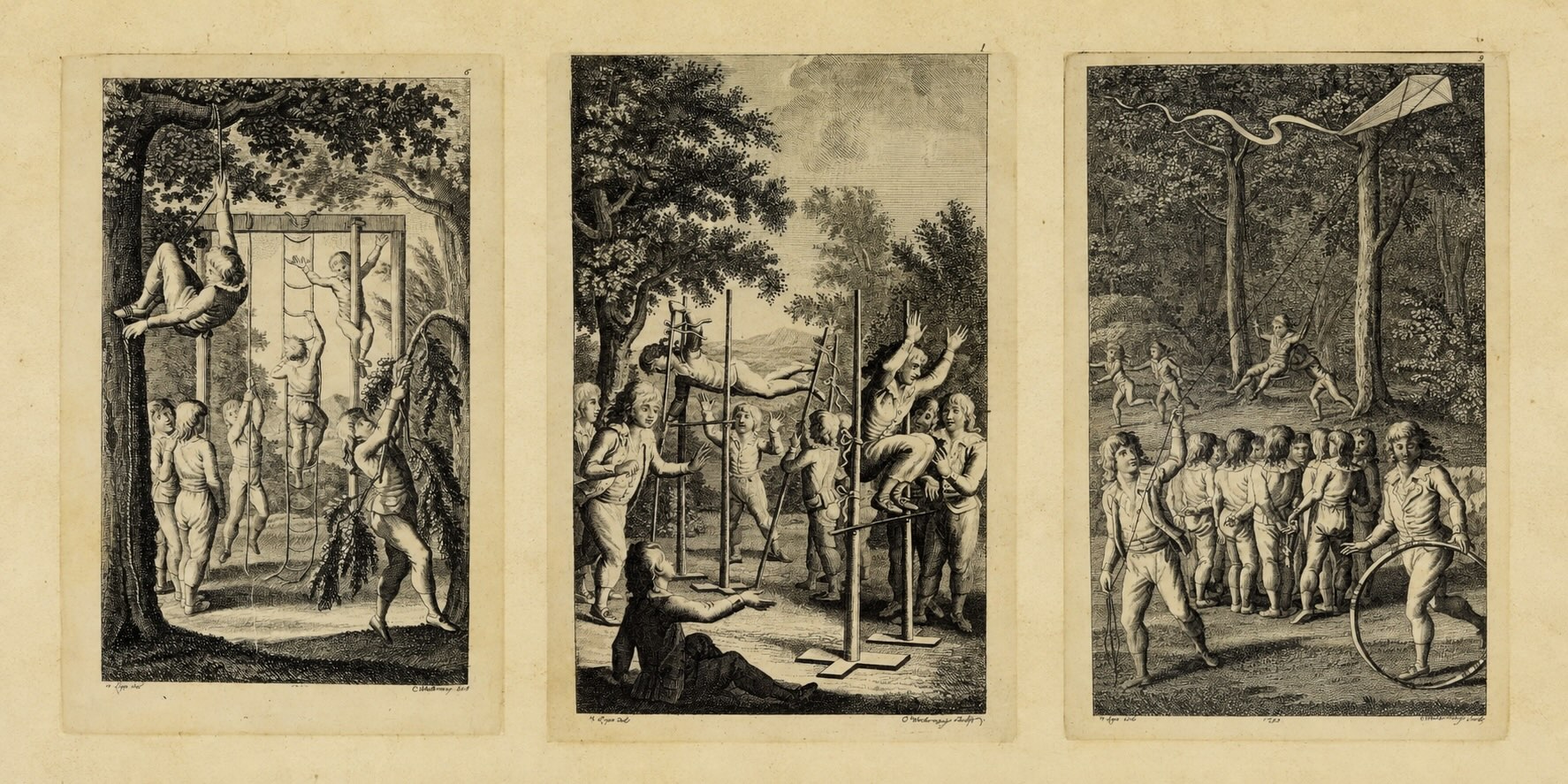
Image: Engravings from Johann Christoph Friedrich GutsMuths’s Gymnastik für die Jugend (Gymnastics for Youth, 1793), one of the earliest systematic manuals of gymnastics and physical education for young people. Digitized by the Wellcome Library; Public Domain. AI-modified.